Dongling Pass
The Romance of the Three KingdomsDongling Pass is a checkpoint on the route Guan Yu’s convoy takes north through Cao Cao’s territory. Its guarded crossing turns the question of whether the party can travel freely into a direct confrontation: Guan Yu refuses to delay or leave the women behind, kills the commander who blocks him, and then pardons the remaining soldiers.
The checkpoint and the journey
After leaving a small farm, Guan Yu and the convoy set out for Luoyang. At the border of Cao Cao’s territory, they reach Dongling Pass, where a commander and five hundred men are on guard. The commander is surprised that the party intends to travel north across the river, toward territory held by Yuan Shao, whom Cao Cao’s side considers an enemy.
The commander asks for written permission. Guan Yu explains that the convoy had to leave at short notice and had no time to obtain formal papers. When the commander proposes that they may proceed only if the women are left behind as security, the checkpoint ceases to be a routine inspection: passage now depends on accepting a condition Guan Yu will not permit.
The clash at the gate
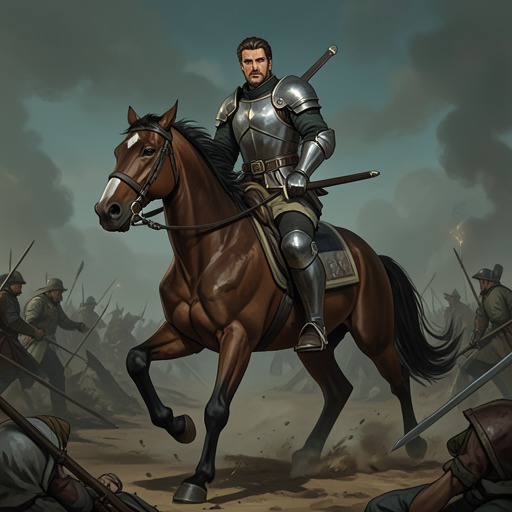
Guan Yu rejects the delay and draws his sword. The commander withdraws, then returns with his men armed and ready to stop the convoy. When he challenges Guan Yu to try to pass, Guan Yu charges and kills him with a single blow.
The outcome is not a general attack on the guards. Terrified by the commander’s death, the soldiers bow down, and Guan Yu pardons them. The convoy passes through Dongling Pass and continues toward Luoyang. The episode thus combines forceful resistance at the point of obstruction with restraint toward the defeated rank and file.
Place in the route
The passage through Dongling Pass is one encounter on the convoy’s journey through Cao Cao’s territory. Immediately afterward, the governor Han Fu hears that Guan Yu is advancing and becomes alarmed. Because Guan Yu has no papers, Han Fu treats him as a fugitive who must be stopped, and he and his adviser consider a trap. The pass therefore marks not the end of the danger but the point at which the journey’s conflict with local authorities becomes explicit.
Dongling Pass functions as a narrative bottleneck: its small garrison can halt a whole convoy, and the lack of paperwork gives the guards a stated reason to challenge its movement. Yet the commander’s demand for the women as security makes the dispute more than a question of authorization. Guan Yu’s refusal, decisive action, and pardon of the surviving soldiers establish how he will handle this first barrier on the route: he will not accept the imposed delay, but neither does he punish every guard once resistance has ended.